
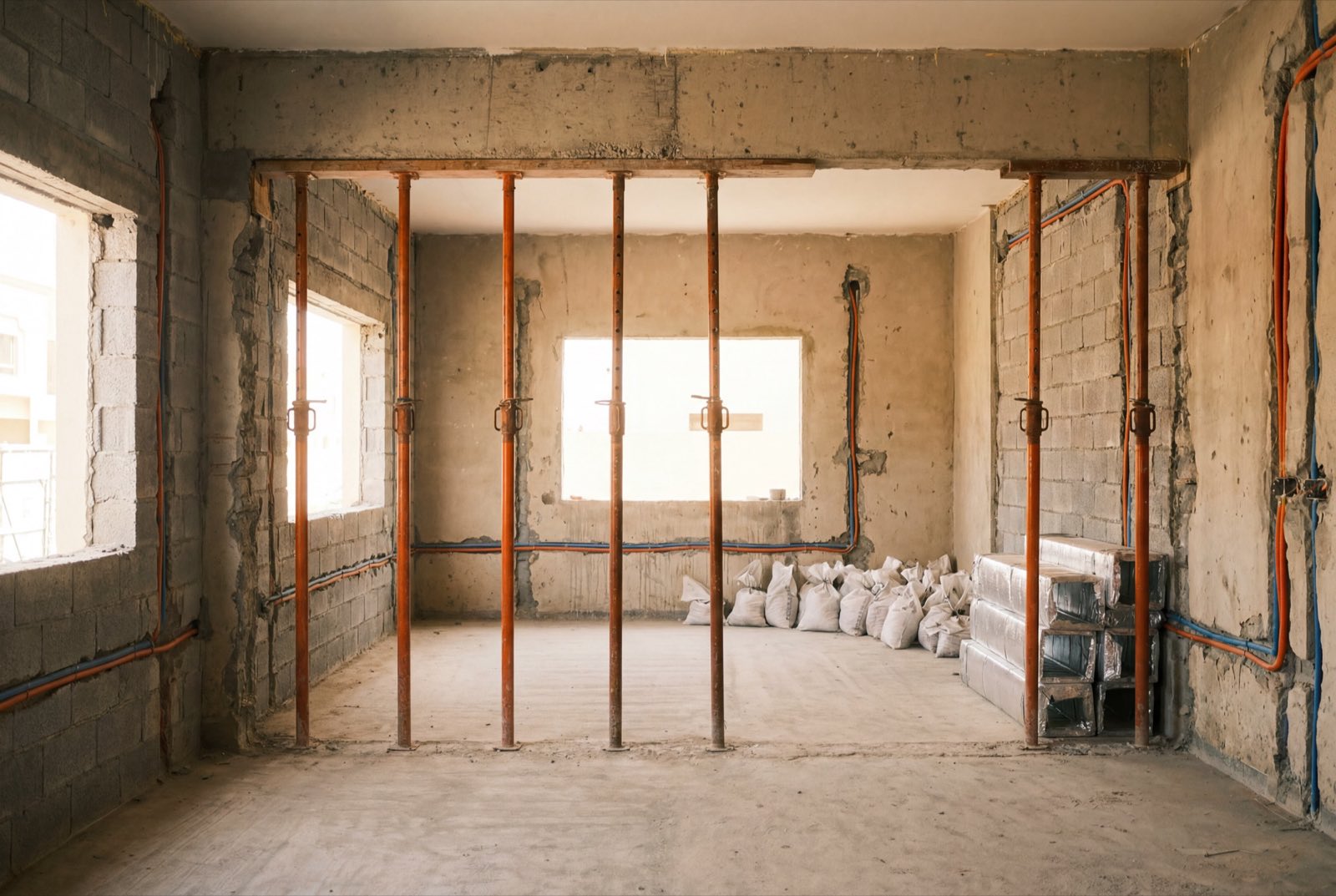
What “strip to shell” actually means
Taking a home back to its bones is not a demolition – it is the only honest way to fix one that has stopped working for the people in it.
Strip to shell means taking a home back to its structural bones – past the finishes, past the partitions, past every service buried in the walls – and rebuilding from there: layout, MEP, floors, ceilings and the joinery that makes it a home again. It is the option a villa reaches for once patching has run out of road.
What actually comes out
Nearly everything, and it is worth being plain about that. Partitions, ceilings, flooring, wiring, pipework, the joinery of earlier decades – out, bagged and gone. What stays is the structure itself: the walls that carry the building, the slab, the roof. In a villa that has been altered more than once, the strip is often the first time in years that anyone has seen the house as it actually is, rather than as a stack of earlier decisions. We photograph it at this stage. Families are sometimes puzzled by that, until they see the pictures later and understand – this is the only moment a house ever tells the whole truth.
Why the services matter more than the finishes
The honest reason to strip a house is rarely the finishes – it is what sits behind them. Electrical, plumbing and air conditioning in an older Dubai villa were sized for the family and the habits of the year it was built, not for the kitchen island, the second fridge or the bathroom that arrived in a renovation nobody fully documented. Re-doing the services at shell stage means routing everything once, properly, against the new layout – rather than working around whatever is already buried. It is the least visible money a family will ever spend on their home, and the money that decides whether the finished rooms behave as well as they look.
This is where the drawings earn their keep. Every socket, light, air-conditioning outlet and drain is agreed on paper before a wall closes – so the joinery that arrives months later fits services that were designed for it, not services discovered by it.
Patch or strip – how to tell which one you need
A patch – paint, floors, a new kitchen – is the right answer when the layout works and the services underneath are sound. Strip to shell earns its cost when the layout no longer suits the life inside it, when the services are tired, or when years of small renovations have left the house without one coherent plan. One of our villa rebuilds went further still: the strip ran inside and out, with the hardscape and planting redrawn in the same set of drawings, so the garden and the rooms answer to the same light and the same life, rather than being stitched together afterwards.

What a family should ask before committing
Three questions do most of the work. What is being replaced, rather than refreshed. Who carries the approvals and the authority sign-offs. And who holds the one programme that structure, MEP, finishes and joinery all answer to. A rebuild run under one contract moves calmly; the same scope split across separate trades has more places to lose its thread – usually somewhere in the middle of the build, where nobody is quite in charge.
It is worth asking, too, who will explain it all while it happens. A family does not need to read a services drawing. They need one voice that will walk them through it in plain terms, say what is worth building – and say, just as clearly, what is not.
What it looks like when it is done properly
Invisible. Nobody visiting a finished rebuild ever asks which wall moved or which pipe changed its path. What they notice, without quite knowing why, is that doors land softly, switches sit where a hand expects them, and light falls where the evening actually happens. That quiet is the whole point of going back to the bones – and the reason we would rather take a house apart properly once than dress it twice.
Questions, answered plainly
- What is the difference between a renovation and a strip-to-shell rebuild?
- A renovation updates finishes and layout within what is already there. A strip-to-shell rebuild takes the home back to its structural bones and rebuilds services, layout and finishes together.
- Does strip to shell include the garden and the exterior?
- It can. When hardscape and landscaping are drawn alongside the interior, the whole property is designed to one plan instead of two.
- How long does a strip-to-shell villa rebuild take?
- It depends on the villa’s size and scope. The honest answer is worked out at the drawings stage, once the extent of the strip is confirmed.