
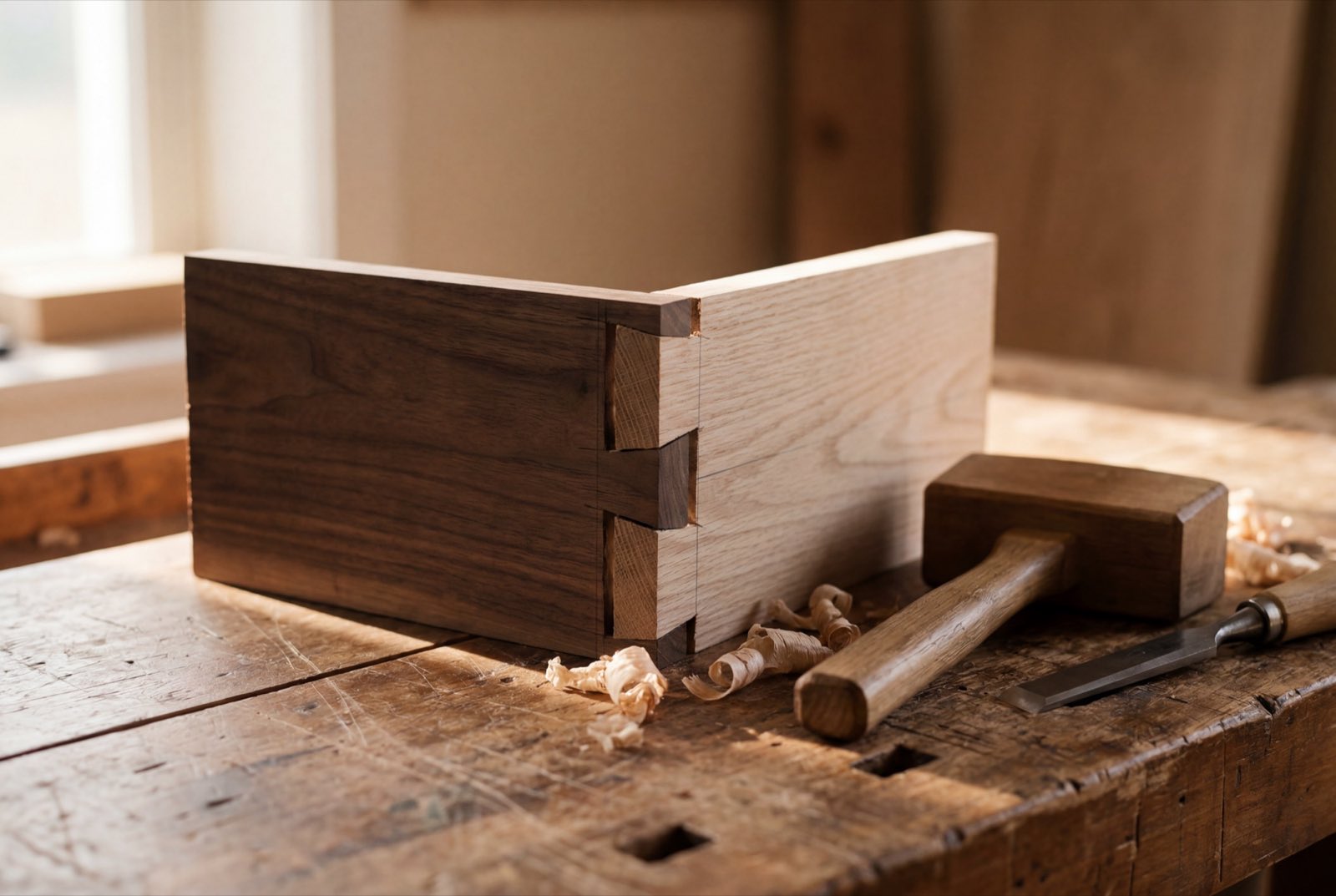
The art of the join
The art of the join is not a phrase we put on a wall. It is the reason a room still closes the way it should, ten years on.
A join is the point where two pieces of material meet and, if the work is right, disappear. The art of the join is craft spent entirely on a moment nobody is meant to see – and it is the clearest measure of a workshop’s standard, because it is the one place with nowhere to hide.
The joint you’re not supposed to see
Look at a well-made drawer and you will not find the dovetail that holds it together – not because it is hidden, but because it is cut so cleanly that it reads as a single piece of wood. That is the whole discipline in one detail: joinery that announces itself is joinery that has already failed at the one job it was given. The art of the join lives in every seam a hand runs over without finding a fault, and in the pieces a guest never thinks to inspect, because nothing about them invites suspicion.
A joint that needs to be admired is one that has already failed.
What the eye can check, and what only the hand can
A drawing can promise a flush reveal, a level door, a seam that disappears. It cannot deliver one. That happens on the bench, with a chisel and a hand that has cut the same joint enough times to know when the timber is telling it something the drawing did not account for. A screen renders a perfect corner instantly; a joiner earns one, board by board, adjusting for the fact that real timber moves, breathes and occasionally disagrees with the plan in ways a render never has to.
Why permanence is a decision, not an accident
A finish can be made to look right in a photograph in an afternoon. A finish that still closes properly in ten years is the result of decisions made before a single board was cut – how a joint is fitted, how it is allowed to move with the timber, how it is finished to survive a Dubai climate rather than merely suit one for a season. Permanence is not a material. It is a sequence of decisions that nobody but the workshop ever has to think about again.
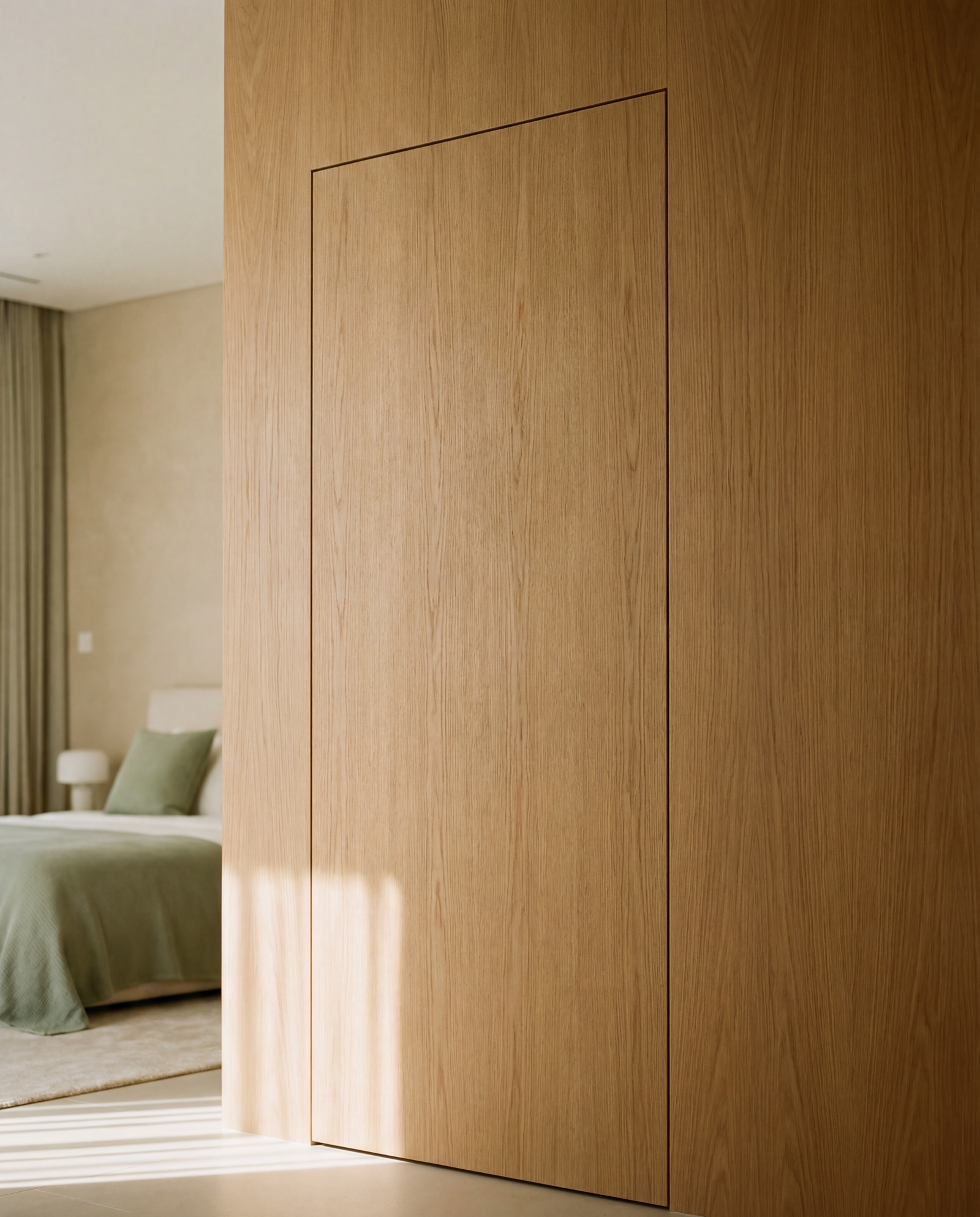
What “Built to Remain” actually asks of a workshop
It asks for a bench, not a brochure. Built to Remain is only as true as the joinery behind it, which is why the work happens in our own workshop in Al Quoz rather than being drawn by us and made by whoever is available that month. The same hands that cut a joint are the hands that fit it on site, which closes the loop between what was drawn and what actually gets delivered – and leaves nowhere for a shortcut to hide between the two.
The confidence of a quiet detail
The rooms we build are not meant to ask for attention on the way in. They are meant to still be quiet on the day something is tested – a door swung a thousand times, a drawer loaded and unloaded through a decade of ordinary life – and to give nothing away when it is. Confidence, in a workshop, looks like restraint: the temptation to add a flourish is usually strongest exactly where a clean joint would have done the job on its own. That is the art of the join: not a flourish, but a promise kept in a place nobody thought to check.
It is not a decoration on the work. It is the work – the part of it we are proudest of precisely because so few people will ever see it, and because remaining unnoticed was always the point.
Questions, answered plainly
- What does “the art of the join” mean?
- It refers to the craft spent on joinery details that are built to be invisible once finished – the measure of quality is that nobody notices them.
- Why does The Toolkit make its own joinery rather than outsourcing it?
- Making joinery in-house, in our Al Quoz workshop, means the hands that cut a joint are the same hands that fit it – so what was drawn is what gets delivered.
- Is “Built to Remain” just a slogan?
- No – it describes a standard of joinery and finishing meant to hold up over years of ordinary use, not a claim made without the workshop to back it.